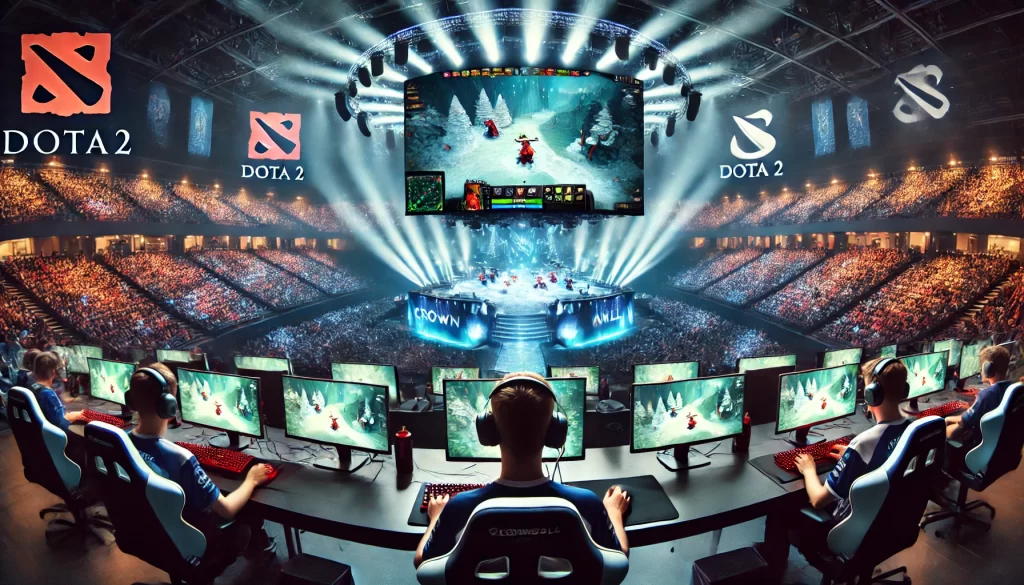
In a move that has taken the Dota 2 esports world by surprise, Natus Vincere (NAVI), one of the most storied organizations in competitive gaming, has officially promoted its junior roster to the position of main team. This unexpected yet calculated decision comes in the wake of a strong series of performances by NAVI Junior during the PGL Wallachia Season 5 qualifiers and subsequent qualification for two of the year’s most prestigious tournaments—the Esports World Cup and The International 2025 (TI 2025).
This article explores the reasoning behind NAVI’s strategic transition, the history and performance of the junior roster, and what this means for the future of the organization as well as the competitive Dota 2 landscape.
A Brief History of NAVI in Dota 2
Founded in 2009 and rising to prominence shortly after, NAVI became a household name in the Dota 2 scene by winning the inaugural The International in 2011. With legendary players like Danil “Dendi” Ishutin and Clement “Puppey” Ivanov, NAVI quickly established itself as a powerhouse.
However, the organization’s Dota 2 division has seen mixed results in the last decade. Despite maintaining a loyal fanbase, NAVI has struggled to return to its former dominance, often falling short in major tournaments and frequently changing its roster in search of a winning formula.
The establishment of NAVI Junior was initially intended as a developmental initiative to scout, train, and mold young talent—similar in philosophy to academy systems in traditional sports.
NAVI Junior’s Ascent
NAVI Junior, formed in late 2022, has quietly been building momentum in Tier 2 and Tier 3 tournaments. The team has participated in regional qualifiers, online leagues, and lower-tier LANs, gaining valuable experience and gradually earning a reputation as a disciplined and promising squad.
Their real breakthrough, however, came during the PGL Wallachia Season 5 qualifiers. Despite being underdogs, NAVI Junior defeated several higher-ranked teams, showcasing tactical depth, mechanical skill, and exceptional synergy. Their performance earned them a spot in both the Esports World Cup and TI 2025 qualifiers, where they again defied expectations and secured qualification.
It was at this point that NAVI’s management began to reconsider the structure of its Dota 2 division. With the main team underperforming and failing to qualify for major events, the decision to elevate NAVI Junior became not only a bold move but also a logical one.
Official Statement and Roster Changes
On June 18, 2025, NAVI released an official statement confirming that the Junior roster would fully replace the main lineup effective July 1, 2025. The announcement cited several reasons:
- The impressive qualification streak of the Junior team for two Tier 1 events.
- The need for fresh energy and consistent performance in the first division.
- A long-term vision for building a unified, stable team rather than patchworking results through frequent roster changes.
The current NAVI Junior roster that will now represent the main team includes:
- Alexei “Shade” Morozov (Captain / Mid)
- Ilya “Crimsun” Petrov (Carry)
- Victor “Doppler” Kuzmin (Offlane)
- Daniel “Yarbo” Yarkov (Soft Support)
- Sergei “Flick” Ivanenko (Hard Support)
Each of these players is under the age of 22, and several of them had been scouted from Eastern European pub ranks and refined through NAVI’s training programs.
What Makes This Move Significant?
NAVI’s decision to fully promote its junior squad is more than a simple roster change—it signals a shift in how esports organizations might operate in the future. The esports industry, particularly in games like Dota 2, has long been dominated by established names, many of whom have transitioned from team to team in pursuit of short-term success.
By contrast, NAVI appears to be investing in sustainable growth, internal development, and long-term cohesion. Similar approaches have been tested by other organizations—such as Team Spirit’s investment in CIS talent—but NAVI is taking it further by betting on an entire academy roster at the highest level.
The move also underscores the rising importance of infrastructure and talent pipelines in esports. As the competitive landscape becomes more saturated and globalized, organizations that develop talent internally may gain a significant edge in consistency and loyalty compared to those relying on high-profile signings alone.
Reaction from the Community
The Dota 2 community has reacted with a mixture of surprise, admiration, and curiosity. Fans have long expressed frustration with NAVI’s lackluster results in recent years, and many view this change as a necessary reset.
Prominent analysts have praised NAVI’s decision as both courageous and forward-thinking. Renowned caster Andrew “Jenkins” Yip commented on his podcast:
“This is the kind of high-risk, high-reward move that could bring NAVI back into the spotlight—or crash spectacularly. But at least they’re committing to a direction instead of staying stagnant.”
Former NAVI players like Dendi have also offered support, noting the importance of giving younger players a platform on the biggest stage.
Expectations for TI 2025
With TI 2025 set to take place in Hamburg this September, all eyes will be on NAVI Junior—now the official NAVI squad—to see if they can hold their own against the world’s best. The group stages will be a crucial testing ground for this young roster, which, while mechanically strong, still lacks experience on the big stage.
NAVI’s goals for the tournament will likely be measured. While few expect them to win TI outright, a solid top-8 or even top-6 finish would be considered a major success and proof that their youth investment is paying off.
Moreover, their journey will be followed closely by other organizations evaluating similar academy models. Should NAVI’s gamble pay off, it could very well start a trend of teams prioritizing internal growth over external recruitment.
NAVI’s decision to elevate its junior team to the main roster is one of the most compelling Dota 2 stories of the year. It reflects a changing philosophy in esports management—one that values structure, development, and vision over short-term fixes. Whether this bold strategy will yield immediate results remains to be seen, but it has already sparked discussions across the industry.
In a game where timing, synergy, and risk-taking are everything, NAVI has made a move worthy of its legacy. The only question now is: can NAVI Junior rise to the challenge of The International?